

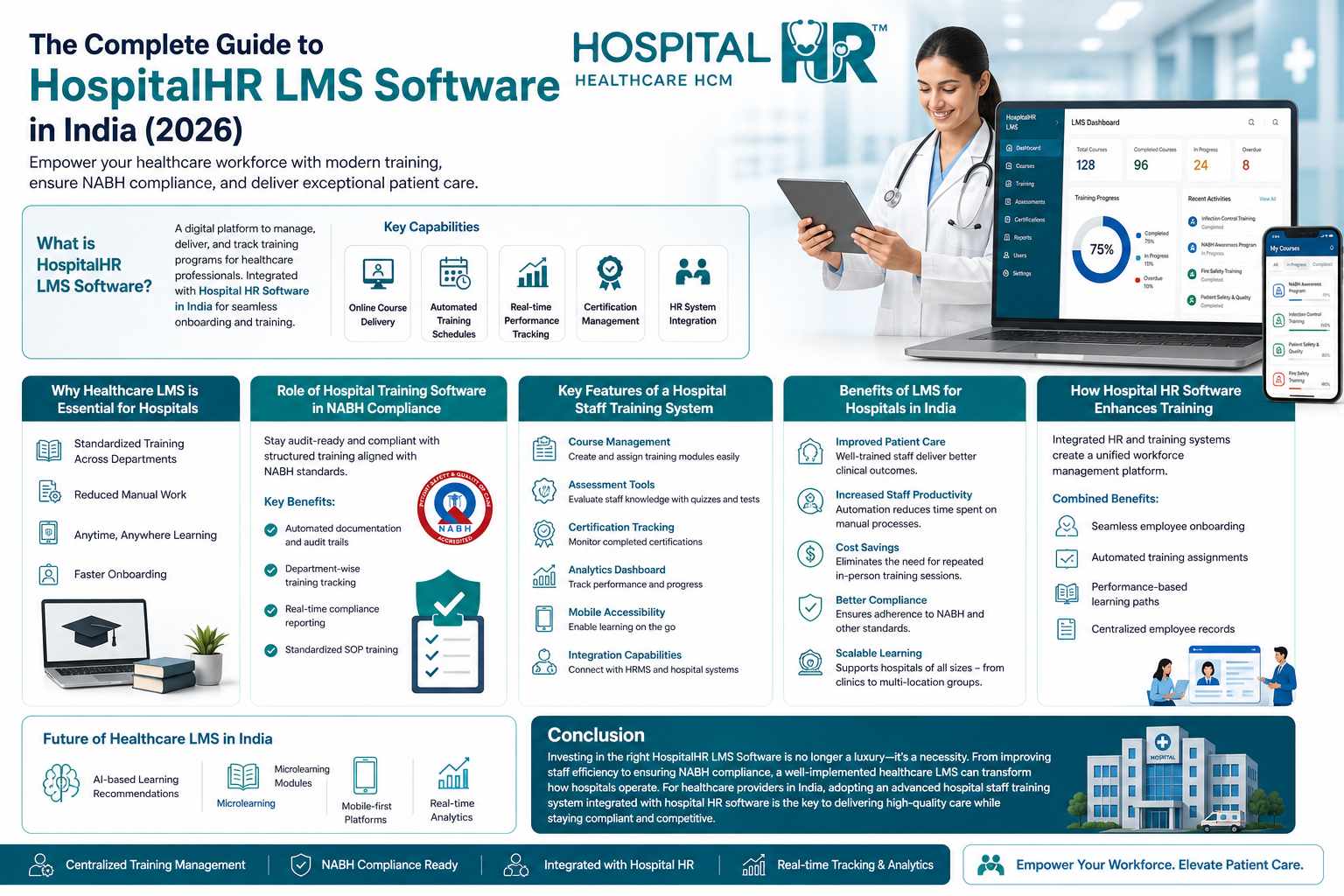

In today’s fast-evolving healthcare environment, continuous learning is no longer optional—it’s essential. Hospitals must ensure that every staff member, from doctors to administrative teams, stays updated with the latest medical practices, compliance requirements, and patient care standards.
This is where hospital training software plays a critical role. With the rise of digital transformation, modern hospitals are adopting healthcare LMS platforms to streamline staff training, ensure compliance, and improve overall efficiency.
What is HospitalHR LMS Software?
HospitalHR training software is a digital platform designed to manage, deliver, and track training programs for healthcare professionals. It acts as a centralized hospital staff training system, enabling hospitals to train employees efficiently and consistently.
NABH & JCI Reference Mapping for HospitalHR LMS Content
Chapter:     HRM (Human Resource Management)

Key Areas:   HRM-1, HRM-2 (Staff Planning, Recruitment, Training)

Chapter:     SQE (Staff Qualifications and Education)

Key Areas:   SQE.1, SQE.2 (Staff competency & training systems)
Why Healthcare LMS is Essential for Hospitals
A healthcare LMS is specifically built for the unique needs of medical institutions. It ensures that training is not just completed—but completed effectively.Here’s why hospitals are rapidly adopting LMS platforms:
Standardized Training Across Departments
Hospitals can deliver uniform training modules to nurses, doctors, and support staff, ensuring consistency in patient care.
NABH: HRM-3 (Staff Training & Development)
JCI:  SQE.3 (Staff education & ongoing training)
Reduced Manual Work
Digital training eliminates paperwork and reduces administrative burden by automating tracking and reporting.
NABH: IMS (Information Management System) – IMS-4
JCI:  MOI (Management of Information) – MOI.9
Anytime, Anywhere Learning
Staff can access training modules anytime, which is crucial for shift-based hospital environments.
NABH: HRM-3, IMS-4
JCI:  SQE.4 (Continuous education)
Faster Onboarding
New employees can be trained quickly using structured onboarding programs integrated with hospital HR systems.
NABH: HRM-2 (Induction Training)
JCI:  SQE 2.1 (Orientation of staff)
Role of Hospital Training Software in NABH Compliance
Meeting accreditation standards is one of the biggest challenges for hospitals in India. A robust NABH compliance training software helps healthcare organizations stay audit-ready at all times.
Platforms like digital training systems are increasingly being used to implement structured learning aligned with NABH standards across departments.
NABH:
- Chapter: HRM + CQI
- HRM-3 (Training Programs)
- CQI-2 (Continuous Quality Improvement through training)
JCI:
- Chapter: SQE + QPS
- SQE.3 (Education & Training)
- QPS (Quality and Patient Safety) – QPS.2
Key Benefits Mapping
| Audit Trails | IMS-5 | MOI.10 |
| Dept-wise Training | HRM-3 | SQE.3 |
| Real-time Compliance | CQI-4 | QPS.4 |
| SOP Training | AAC, COP, HRM | SQE + IPSG |
Key Features of a Hospital Staff Training System
When choosing a hospital staff training system, hospitals should focus on features that enhance both learning and operational efficiency.
Course Management
- NABH: HRM-3
- JCI:3
Assessment Tools
- NABH: HRM-4 (Performance Appraisal)
- JCI:4 (Competency Assessment)
Certification Tracking
- NABH: HRM-5 (Credentialing)
- JCI:9 (Staff Credentials & Privileges)
Analytics Dashboard
- NABH: CQI-4 (Data Analysis)
- JCI:5 (Performance Measurement)
Mobile Accessibility
- NABH: IMS-4
- JCI:9
Integration Capabilities
- NABH: IMS + HRM Integration
- JCI: MOI + SQE Integration
Benefits of LMS for Hospitals in India
Improved Patient Care
- NABH: COP (Care of Patients), CQI
- JCI: COP + QPS
Increased Staff Productivity
- NABH: HRM-4
- JCI:4
Cost Savings
- NABH: FMS + IMS (Operational Efficiency)
- JCI: FMS (Facility Management & Safety)
Better Compliance
- NABH: All Chapters (HRM, CQI, IMS)
- JCI: All Chapters (SQE, QPS, MOI)
Scalable Learning
- NABH: HRM + IMS
- JCI: SQE + MOI
How Hospital HR Software Enhances Training
Modern hospital HR software in India goes beyond payroll and attendance. It integrates directly with training systems to create a unified workforce management platform.
Seamless Employee Onboarding
- NABH: HRM-2
- JCI:2
Automated Training Assignments
- NABH: HRM-3
- JCI:3
Performance-Based Learning
- NABH: HRM-4
- JCI:4
Centralized Employee Records
- NABH: IMS-2 (Data Management)
- JCI:2 (Information Management)
Future of Healthcare LMS in India
The future of healthcare LMS is driven by technology and personalization. Hospitals are increasingly adopting:
AI-Based Learning
- NABH: IMS + CQI (Data-driven improvements)
- JCI: QPS + MOI
Microlearning Modules
- NABH: HRM-3
- JCI:3
Mobile-first Platforms
- NABH: IMS-4
- JCI:9
Real-time Analytics
- NABH: CQI-4
- JCI:5
With digital transformation accelerating, hospital training software will become a core component of every healthcare institution’s infrastructure.
Conclusion (Overall Compliance Alignment)
NABH:
-
- HRM (Human Resources)
- CQI (Quality Improvement)
- IMS (Information Management)
JCI:
-
- SQE (Staff Qualifications & Education)
- QPS (Quality & Patient Safety)
- MOI (Management of Information)
Investing in the right hospitalHR learning software is no longer a luxury—it’s a necessity. From improving staff efficiency to ensuring NABH compliance, a well-implemented healthcare LMS can transform how hospitals operate.
For healthcare providers in India, adopting an advanced hospital staff training system integrated with hospital HR software is the key to delivering high-quality care while staying compliant and competitive.